

Saint George and the Dragon: History, Symbol, and Glyptics
How can an entire battle fit into the space of a small stone?
A knight, a rearing horse, a lance cutting across the composition, and a dragon curled beneath the hooves: just a few elements are enough to make the image of Saint George and the Dragon instantly recognizable.
For centuries, this scene has appeared in frescoes, altarpieces, miniatures, engravings, and gems. Each era has transformed it, adapting its armor, landscapes, and proportions without altering its essential structure. It is precisely this ability to distill a complex narrative into a compact form that brings it so close to glyptics: the art of entrusting images, symbols, and identities to the surface of a precious material on a minute scale.

Saint George and the dragon transformed into a contemporary cameo to carry with you.
Before the dragon: the martyr
The figure of Saint George predates his most famous battle. Historical information about his life is fragmentary and does not allow us to reconstruct a definitive biography. Christian tradition remembers him as a soldier who was martyred during the persecutions of Emperor Diocletian after refusing to renounce his faith.
The earliest veneration of the saint, however, was not connected with a monster or a princess. The episode of the dragon belongs to a later phase: it developed during the Middle Ages, when George became one of the most important warrior saints in European culture. It is therefore useful to distinguish the possible historical core of the martyr from the chivalric legend that transformed his image.
The city, the princess, and the dragon
The version destined to exert the greatest influence on Western art was disseminated by the Legenda aurea, the famous collection of saints' lives compiled in the 13th century by Jacobus de Voragine.
According to the story, a dragon was terrorizing the city of Silene, in Libya, and preventing the inhabitants from approaching a spring. To appease it, the population first offered it animals and then human victims chosen by lot. When the lot fell on the king's daughter, the young woman was led outside the walls and left to wait for the monster.
George arrived just as the princess was about to be sacrificed. He confronted the dragon and wounded it with his lance. In one of the most singular parts of the tale, he did not kill it immediately: he asked the young woman to tie her girdle around its neck, and the monster, now tamed, was led toward the city. Only later did George defeat it definitively.
In works of art, the narrative is almost always compressed into the most dramatic instant: the lance is about to strike the dragon, and the entire outcome of the story seems to depend on that gesture.

Bernat Martorell, Saint George and the Dragon, 1434–35, tempera on panel, Art Institute of Chicago.
In the painting by Bernat Martorell, created in 1434–35, the combat occupies the center of a very dense scene. The panel belonged to an altarpiece dedicated to the saint and was originally surrounded by four minor episodes from his history. The richness of the details transforms the duel into a public and monumental narrative: the princess observes, the city waits, and the ground retains the traces of previous victims.
How to recognize Saint George
Over the centuries, artists have modified style, clothing, and setting, but have preserved a surprisingly stable visual grammar.
The saint almost always appears on horseback. His figure dominates the upper part of the composition, while the dragon is forced downward. The lance creates a strong diagonal and connects the knight to the monster. The princess, the city walls, or a distant landscape complete the story and remind us of what is in danger.
The medieval dragon is often smaller and more serpent-like than the gigantic creatures of modern fantasy. It does not need to occupy the entire scene: its position, crushed against the ground, is enough to suggest its defeat. The halo identifies George as a saint, while the cross on his shield or garment underscores his Christian character.

Rogier van der Weyden, Saint George and the Dragon, circa 1432–35, oil on panel, National Gallery of Art, Washington
The small panel by Rogier van der Weyden, painted around 1432–35, shows this construction with particular clarity. George, protected by Gothic armor, guides the lance along almost the entire height of the work. The winged dragon is surrounded by bones and skulls; Princess Cleodolinda is kneeling nearby, and beyond the hills, a fortified city can be glimpsed.
Tradition associates the saint with Cappadocia and places the dragon episode in the city of Silene, in Libya. Van der Weyden instead transfers the scene to a 15th-century Flemish landscape. The artist does not seek an archaeological reconstruction: he makes the story present to his own audience, clothing the ancient saint in the visual forms of his own time.
An image capable of crossing centuries
It is this adaptability that explains the extraordinary fortune of the subject. Saint George can appear as a soldier, medieval knight, or Renaissance hero; the dragon can look like a serpent, a winged reptile, or a fantastic creature. The deep structure of the image, however, remains intact.
An Italian testimonial is preserved in the Fénis Castle, in the Aosta Valley. The painting, dated around 1450 and attributed probably to Giacomo Jaquerio or his workshop, shows how widespread the theme was even in the figurative culture of the Alpine region.

Saint George and the Dragon, circa 1450, attributed to Giacomo Jaquerio or his workshop, Fénis Castle, Aosta Valley.
The language of sculpture also embraced the same scene. In the marble relief by Giovanni Francesco Rustici, made around 1515 and measuring about 29 × 48 centimeters, the knight and the dragon emerge from a shallow surface. The work, preserved at the Museum of Fine Arts in Budapest, is particularly interesting for understanding the transition from painting to sculpted material. The museum’s photograph is not indicated as Open Access: for this reason, it is preferable to link to the page without reproducing the image on the blog.
An older echo: the hero and the monster
The form of the knight striking a defeated creature from above does not originate entirely in the Middle Ages. The Getty Museum observes that the Christian image of Saint George on horseback may have drawn on a much older model: Bellerophon on Pegasus fighting the Chimera.
This is not about identifying the two stories or establishing a simple lineage. It is more accurate to speak of a continuity of visual language: different cultures can entrust new meanings to an already understandable structure—the hero above, the monster below, the weapon as the axis of action. Art history is also traversed by these silent migrations of images.
When an entire story fits into a small format
The scene of Saint George seems complex, yet it preserves its readability even when reduced to a few centimeters.
The engraving by Martin Schongauer, executed between 1470 and 1491, measures just 5.7 × 7.4 centimeters. Horse, knight, weapon, and dragon are organized with such precision that the eye immediately understands the action. There is no need to describe every detail: the composition works because each element occupies an essential place.

Martin Schongauer, St. George Slaying the Dragon, 1470–91, engraving, 5.7 × 7.4 cm, The Metropolitan Museum of Art
It is precisely here that the scene naturally meets the art of glyptics. The gem engraver must make a similar choice: to reduce without impoverishing, to establish hierarchies, to transform bodies and movement into readable lines, to ensure that an entire story continues to live on the surface of a stone.
Saint George in medieval gems and cameos
Before becoming the protagonist of a contemporary ring, Saint George was already present on precious objects destined to be worn, touched, and kept.
A Byzantine jasper cameo, dated between 1100 and 1300 and today at the Metropolitan Museum, shows the saint with sword and shield. The museum points out how such semi-precious stone carvings were prized as objects of personal devotion and how the saint primarily assumed the role of protector in them. Observe the cameo on the Met's website.
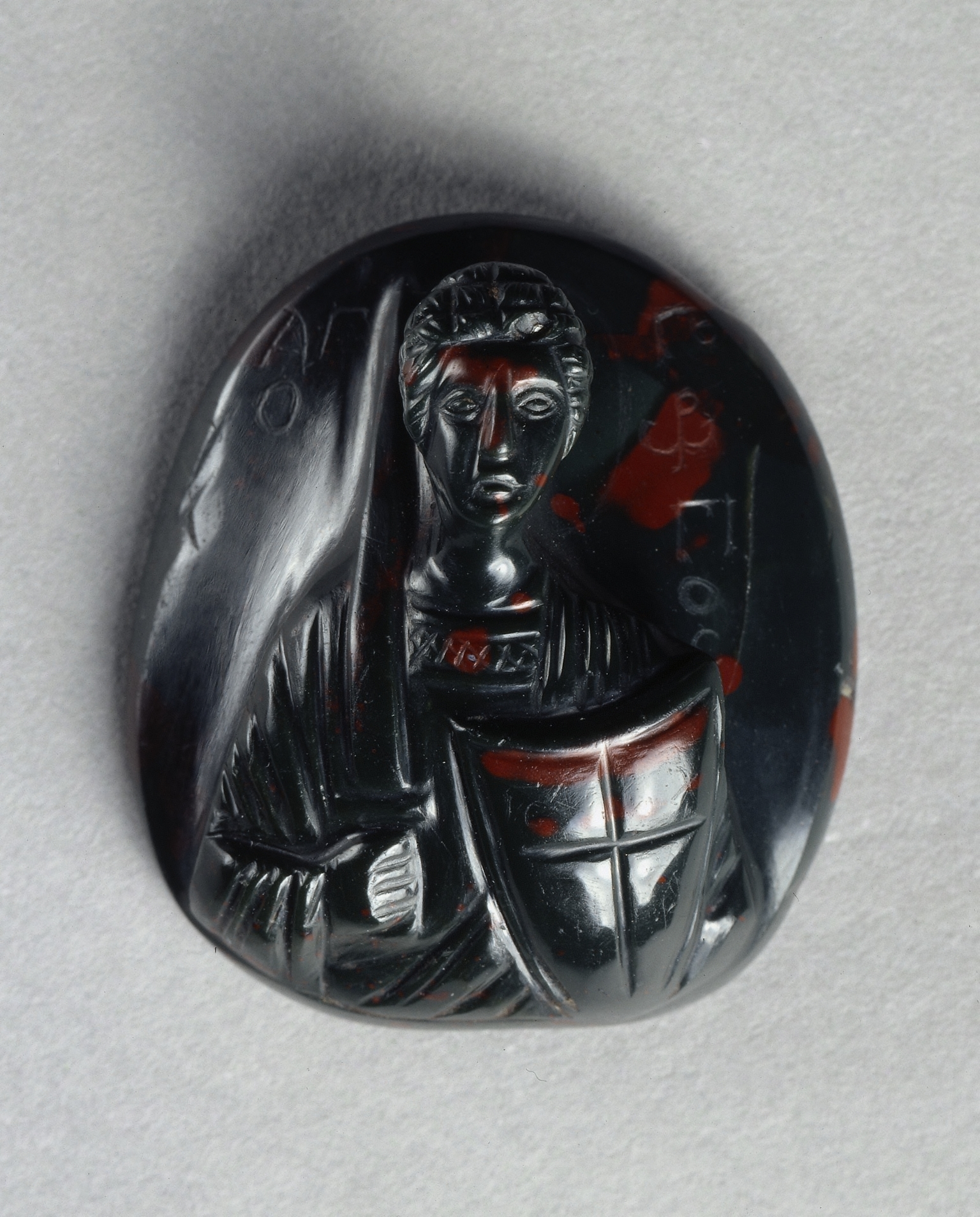
Even more explicit is the heliotrope cameo made in Constantinople between 1000 and 1100 and preserved at the Cleveland Museum of Art. The small object was originally worn around the neck. Physical proximity to the sacred image—which could be touched or kissed in moments of danger—contributed to its devotional and protective meaning.

Bloodstone Cameo with Saint George, Constantinople, 1000–1100, Cleveland Museum of Art
In the late 15th century, the full combat scene was also engraved in mother-of-pearl. A German medallion today at the Metropolitan Museum measures just over five centimeters. Similar objects could be inserted into reliquaries or, according to a hypothesis noted by the museum, be worn as hat ornaments.

Medallion with Saint George Slaying the Dragon, Germany, late 15th century, mother-of-pearl, The Metropolitan Museum of Art
This medallion constitutes a precedent particularly close to contemporary jewelry: light does not merely illuminate the image but enters the material, continuously modifying its colors and depth.
Saint George in the space of a contemporary cameo
In the Sigillum Stones cameo, the scene does not reproduce a single ancient work. Instead, it takes up the visual language built over the centuries: the moving horse, the diagonal lance, the saint dominating the composition, and the dragon huddled in the lower section.
The image is hand-engraved on authentic Tahitian grey mother-of-pearl. Its natural iridescence brings out green, pink, silvery, and violet reflections depending on the light. Relief and material work together: some details appear sharp, while others seem to emerge and vanish as the ring moves.
Every fragment of mother-of-pearl possesses its own grain and shades. For this reason, no two cameos are perfectly identical: the iconography remains recognizable, but each engraving acquires a different presence.


Saint George and the Dragon cameo, hand-engraved on grey Tahitian mother-of-pearl. Sigillum Stones
How to observe the cameo
To read the composition, one can start with the lance: it is the line that traverses the image and immediately guides the gaze toward the dragon.
Immediately after, the opposing movement of the horse emerges, reared up and reaching forward. The sinuous body of the monster creates a counter-curve in the lower part, while the halo encloses the saint’s figure in a small circle of light.
Finally, it is worth tilting the ring slowly. The shifts in the mother-of-pearl alter the relationships between the figures: details that were dark before may brighten, and seemingly uniform areas reveal unexpected reflections. The image is not perceived all at once, but manifests itself progressively.
Courage, protection, and self-mastery
In its medieval context, the dragon represented evil defeated by faith, and the saint embodied the ideal of the Christian knight. An image that spans centuries, however, can acquire new meanings without losing its history.
Today, Saint George can be chosen as an emblem of courage, protection, and firmness, but also as an image of the confrontation with what appears threatening or uncontrollable. Victory does not stem from strength alone: the knight must maintain direction, govern the horse, and concentrate the action into a single, precise gesture.
When worn, the cameo does not impose an interpretation. As was the case with ancient gems, it concentrates a narrative within the space of a small precious object and lets the wearer attribute a personal meaning to it.
An image to carry with you
From Bellerophon to medieval imagery, from altarpieces to engravings, from Byzantine cameos to contemporary mother-of-pearl, the figure of the hero facing the monster has continued to change shape.
In this cameo, the grand narrative returns to its most intimate expression. The city and the crowd may disappear; what remain are the knight, the horse, the lance, and the dragon. A few signs are enough to preserve centuries of images and transform an ancient legend into something to be worn close to the body.
Sources:
- Art Institute of Chicago — Bernat Martorell, Saint George and the Dragon
- National Gallery of Art — Rogier van der Weyden, Saint George and the Dragon
- The Metropolitan Museum of Art — Martin Schongauer, St. George Slaying the Dragon
- The Metropolitan Museum of Art — Cameo with Saint George
- The Metropolitan Museum of Art — Medallion with Saint George Slaying the Dragon
- Cleveland Museum of Art — Bloodstone Cameo with Saint George
- Museum of Fine Arts, Budapest — Giovanni Francesco Rustici, Saint George and the Dragon
- Fénis Castle — Saint George and the Dragon
- Getty Iconography — Saint George Slaying the Dragon
- Getty Museum — The Chimaera of Arezzo and the comparison with Bellerophon
- Fordham University Medieval Sourcebook — The Golden Legend: St. George
- Art & Object — The History and Iconography of St. George and the Dragon
- Wikimedia Commons — collection of paintings of Saint George and the Dragon